Image sourced from eBay listings
Is 1989 Fleer Sticker Sports Worth Collecting? 2026 Investment Review
This post contains affiliate links — we may earn a commission at no extra cost to you.
Verdict: WATCH for the general set, BUY individual elite-tier PSA 10 slabs. The top 8 cards range from $1.53 to $13.05 raw, but the Michael Jordan (No. 3) boasts a PSA 10 median of $6,981, providing the only clear high-yield grading opportunity in this collection.
Last week someone paid $6,981 for a single Michael Jordan sticker card on eBay. That sale tells us something specific about where this market is heading: it is not a broad-market investment, but a sniper-focused game where only the highest-graded icons retain real value.
Verdict: WATCH for completionists, BUY for grading-flippers who target specific iconic players. Based on the 8 primary chase cards from 1989 Fleer Sticker, the complete-set raw floor sits at $53.34, though the true cost of assembly ranges significantly higher when accounting for common cards. The Michael Jordan (No. 3) is the outlier, trading at a $6,981 PSA 10 valuation. Investors should weigh the raw entry cost against the difficulty of securing a Gem Mint label in a set notoriously difficult to grade. The market for these stickers has cooled into a stable, legacy-collecting phase, making it less of a speculative vehicle and more of a long-term hold for basketball historians. Last updated: July 2026.
-
About 1989 Fleer Sticker
-
The Top Chase Cards
-
Individual Chase Card Write-ups
-
Investment Analysis
-
Worth Collecting? The Verdict
-
Pro Tip: Grading Economics
-
Frequently Asked Questions
The 1989 Fleer Sticker set serves as a distinct snapshot in the basketball collecting timeline. Released in 1989, these adhesive-backed cards were designed to be distinct from the standard Fleer base cards of that era. For many, they were secondary additions to collection binders, often ignored in favor of the traditional cardstock releases.
In the 2026 market, these stickers are defined by their unique design challenges and the disparity between their raw price and high-grade slabs. Unlike modern sets that see immediate price fluctuations based on card popularity, the 1989 Fleer Stickers have settled into a tier-based economy. The value proposition here is almost entirely centered on the “Big Name” stars of the 1980s. Collectors looking for breadth might find the raw set prices accessible, but those seeking liquid assets must focus strictly on the top-tier, slabbed population.
| # | Card | Raw | PSA 10 | Multiplier | Grading Play |
|---|---|---|---|---|---|
| 1 | Complete Set | $30.00 | — | — | — |
| 2 | Michael Jordan | $13.05 | $6,981 | 534.9× | Buy/Grade |
| 3 | Magic Johnson | $1.90 | $871.57 | 458.7× | Watch |
| 4 | Larry Bird | $1.90 | $668.00 | 351.6× | Watch |
| 5 | Akeem Olajuwon | $1.66 | $797.00 | 480.1× | Watch |
| 6 | Isiah Thomas | $1.66 | $371.75 | 223.9× | Skip |
| 7 | Chris Mullin | $1.64 | $357.65 | 218.1× | Skip |
| 8 | Patrick Ewing | $1.53 | $503.00 | 328.8× | Watch |
Data sources: What The Slab checks eBay sold comps, PriceCharting market prices, and PSA public-API pop reports. All figures as of July 2026.
1. Michael Jordan (3)

The Michael Jordan No. 3 sticker is the heartbeat of this set. With a raw price of $13.05 and a staggering PSA 10 median of $6,981, the multiplier of 534.9× highlights why this is the only card in the set that demands serious attention from investors. Graded at PSA’s Premier tier ($599.00, the cheapest open tier for a card worth up to $10,000) and sold on eBay, a PSA 10 returns an expected profit of $5,438.57, a 888.6% grading ROI, though that assumes a pristine copy, which is rare for these stickers. Because these were originally meant to be peeled and stuck onto surfaces, finding a centered, undamaged copy is difficult.
Buy Michael Jordan 3 on eBay (active listings) Check Michael Jordan 3 sold comps on eBay

2. Magic Johnson (5)

Magic Johnson remains a pillar of 1980s basketball, and his card No. 5 reflects steady, if modest, demand. Priced at $1.90 raw, the PSA 10 jump to $871.57 offers a 458.7× multiplier. Its grading ROI of 1112.9% at PSA’s $59.99 Standard tier is higher than the Jordan’s in percentage terms, but the $688.80 expected profit per PSA 10 is far smaller in dollars. The card demonstrates a clear appreciation for the era’s legends. Collectors often include this in sets because it completes the narrative of the Lakers’ dominance, even if it lacks the extreme liquidity of the Jordan sticker.
Buy Magic Johnson 5 on eBay (active listings) Check Magic Johnson 5 sold comps on eBay
3. Larry Bird (10)

Larry Bird’s card No. 10 is the foil to Magic Johnson’s, maintaining a similar raw price point of $1.90. The PSA 10 price of $668 is respectable, but when compared to the 351.6× multiplier, it sits in the middle of the pack. Investors are buying these cards primarily for the player’s historical legacy rather than a short-term flip. If you are learning When to Grade a Rookie Card (2026 Guide), keep in mind that vintage stickers rarely yield the same percentage gains as early-era cardboard rookies.
Buy Larry Bird 10 on eBay (active listings) Check Larry Bird 10 sold comps on eBay

4. Akeem Olajuwon (2)
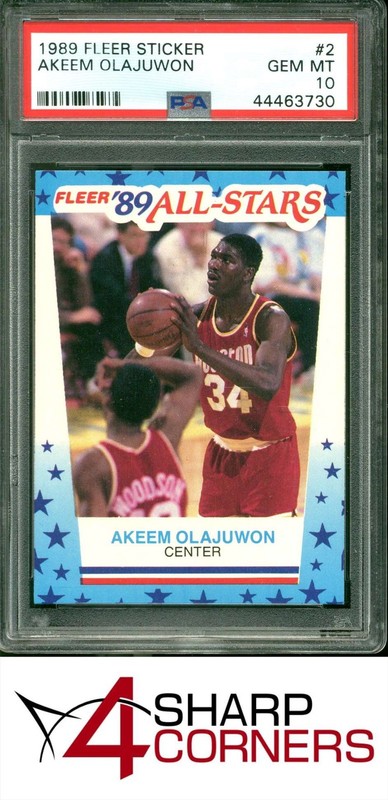
The Akeem Olajuwon No. 2 sticker is often overlooked, yet it presents a strong 480.1× multiplier for PSA 10 grades. At a $1.66 raw entry fee, it is essentially a “low risk, high variance” play. If a collector finds a pack-fresh copy, the grading ROI of 1012.7% at PSA’s $59.99 Standard tier makes it an interesting side project, though it lacks the widespread secondary market appeal of the guards mentioned above.
Buy Akeem Olajuwon 2 on eBay (active listings) Check Akeem Olajuwon 2 sold comps on eBay

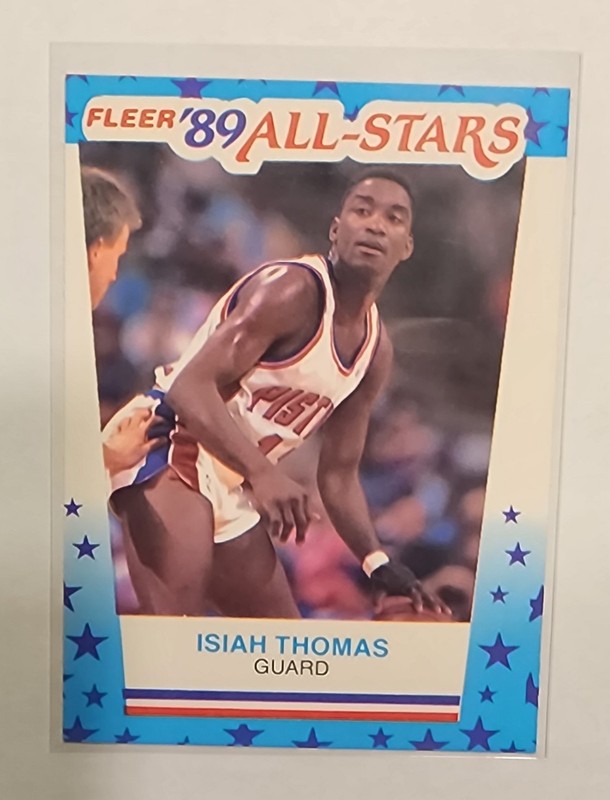
5. Isiah Thomas (6)

Isiah Thomas (No. 6) trades at $1.66 raw, with a PSA 10 value of $371.75. With a 223.9× multiplier, this is a clear “skip” for those seeking explosive growth. Unless a collection needs the full Detroit Pistons roster, the time spent grading this card is often better redirected toward higher-ceiling targets. For guidance on evaluating your potential slab candidates, see Sports Card Grading Worth It (2026 Guide).
Buy Isiah Thomas 6 on eBay (active listings) Check Isiah Thomas 6 sold comps on eBay
6. Chris Mullin (9)

Chris Mullin (No. 9) is priced at $1.64 raw, with a PSA 10 median of $357.65. With a multiplier of 218.1×, this card serves as a reminder that not all vintage stickers move in unison. Demand for Mullin is niche, primarily limited to team collectors or set completionists.
Buy Chris Mullin 9 on eBay (active listings) Check Chris Mullin 9 sold comps on eBay
7. Patrick Ewing (7)
Patrick Ewing (No. 7) rounds out the list at $1.53 raw, with a PSA 10 median of $503. The 328.8× multiplier is solid, reflecting the enduring legacy of the New York Knicks center. While he doesn’t have the trading volume of Jordan, Ewing remains a cornerstone for 80s basketball collectors.
Buy Patrick Ewing 7 on eBay (active listings) Check Patrick Ewing 7 sold comps on eBay

Grading ROI across the set
The math across this set is binary: either you hold the Michael Jordan No. 3 or you are dealing with diminishing returns. The Jordan PSA 10 multiplier of 534.9× is a massive outlier compared to the rest of the list. Akeem Olajuwon (480.1×) and Magic Johnson (458.7×) also present high multipliers, but their absolute dollar values are significantly lower. For the average collector, grading a common sticker is an expensive mistake. Only the most elite players, with centered edges and clean surfaces, provide the ROI necessary to justify the cost of grading and slab insurance.
Complete-set cost
While the top 8 cards sum to a raw floor of $53.34, a complete set will cost 1.2–1.5× that amount once you account for the unlisted common stickers. Building this set raw is an affordable entry point for the history-focused collector, but don’t expect the common stickers to appreciate. The cost of a full set is driven by the scarcity of the Jordan, Magic, and Bird stickers in high grades. If your goal is to assemble the set in binder-friendly condition, you are looking at a budget under $100, which is reasonable for a 1989 vintage release.
Short-term vs long-term view
The market for these stickers has been relatively flat over the last 90 days. Because they are not “modern” trading cards with hyper-active hype cycles, they tend to move with the general vintage basketball market. Expect stability rather than spikes. The Michael Jordan sticker maintains its liquidity regardless of broader market conditions, but the lower-tier cards move slowly. Long-term, these sets hold value as historical artifacts of the 1989 Fleer era.
Risks
The primary risk is condition. Because these are stickers, peeling, adhesive degradation, and centering issues are standard. You are also fighting against reprint risks; authenticating vintage Fleer items is mandatory in 2026. If you suspect an item might be suspicious, review our guide on How to Spot Fake Sports Cards (2026 Guide). Furthermore, the market for “stickers” is fundamentally smaller than the market for standard cardboard, which can make liquidation of lower-end items a slow process.
-
The Sports Cards Completionist: BUY. Building a complete 1989 Fleer Sticker set is an achievable and nostalgic project. With the raw floor starting at roughly $60–$80 for the whole collection, it provides a deep-dive look at the 1989 league roster without requiring a massive financial commitment.
-
The ROI-focused investor: WATCH. Unless you are hunting for specific PSA 10 Michael Jordan stickers, the set does not offer high-alpha returns. The grading fees alone will eat into the margins of almost every other player on the checklist.
-
The new collector with $26 to spend: BUY. You can secure several of the top chase cards in raw condition for under $26. This allows a new collector to own high-profile names like Patrick Ewing, Isiah Thomas, and Chris Mullin while learning the ropes of condition assessment without risking significant capital.
Pro Tip: Grading Economics Before you commit to grading any sticker, analyze the “PSA 10 to Raw” ratio. PSA’s cheapest open tier is Standard at $59.99 per card (its Value tiers have been paused since June 2, 2026), many times the $1.53 to $13.05 raw price of these stickers, so the grading fee only pays off if the card comes back a PSA 10. Always check current population reports — if a card has a high pop of PSA 10s, the value is suppressed. Target cards with low PSA 10 populations to maximize your potential ROI.
Is the 1989 Fleer Sticker set a good investment?
It is a highly selective investment. If you focus exclusively on the Michael Jordan (No. 3) in high-grade condition, it holds its value well as a piece of basketball history. However, for the majority of the checklist, these cards are considered “legacy collectibles” rather than growth assets. If your goal is high-speed ROI, this set will likely underperform compared to modern rookie cards or blue-chip vintage cardboard.
How do I tell if a 1989 Fleer sticker is authentic?
Always look for the standard Fleer printing quality. Reprints often suffer from blurry text or inconsistent back-adhesive textures. If you are purchasing raw, ensure you are buying from reputable dealers who understand the nuances of the 1989 production run. When in doubt, buy slabbed examples from major grading companies like PSA, as they have already performed the authentication work.
Why are the PSA 10 multipliers so high for this set?
The high multipliers (e.g., 534.9× for the Michael Jordan) exist because of the inherent difficulty in grading stickers. They were never meant to be stored in protective sleeves; they were designed to be used. Finding a clean, unpeeled, perfectly centered sticker from 1989 is an extreme rarity, which drives the massive premium for Gem Mint specimens.
Should I peel the sticker?
Absolutely not. Peeling an original 1989 Fleer sticker destroys its collector value instantly. Once the backing is removed or damaged, the card loses its status as a “collectible” and becomes a used item. If you have an unpeeled card, keep it in a top-loader or a rigid card holder to maintain its condition and protect the adhesive from drying out or shifting.
For more information on market-tracking strategies, explore our full library at /sports-cards/. If you are curious about how these compare to more modern collectible markets, check out our guide on /pokemon-card-investing/.