Image sourced from eBay listings
Is 10th Edition MTG Worth Collecting? 2026 Investment Review
This post contains affiliate links — we may earn a commission at no extra cost to you.
Yes, 10th Edition MTG is a “WATCH” for collectors in 2026, particularly for those targeting its foil chase cards, with the top eight cards ranging from $41.19 to $79.99 raw. While the set lacks robust pricing data for graded copies, its current raw market indicates potential for value accumulation, especially for highly sought-after foils.
Most TCG guides are wrong about which cards to grade — and the data proves it. This 2026 investment review of Magic: The Gathering’s 10th Edition reveals a set with nascent but compelling value drivers, primarily concentrated in its foil singles. The current raw market for the top eight chase cards paints an interesting picture for collectors. With a combined raw price of $481.66 for these key cards, the set’s initial floor for a complete raw collection (excluding commons and bulk) is estimated to be between $481.66 and $722.49, assuming a 1.0x to 1.2x multiplier for the overall set cost. The top card, Seedborn Muse [Foil], currently commands a raw price of $79.99. While grading data for PSA 10s is not yet available, the market for these high-demand foils suggests a cautious optimism. This review delves into the specific chase cards, investment potential, and offers a clear verdict for collectors looking to acquire 10th Edition in 2026.
Verdict: WATCH. Based on 8 chase cards from 10th Edition, the complete-set floor sits around $481.66 raw, with the top card, Seedborn Muse [Foil], at $79.99 raw. Last updated: July 2026.
In This Article
-
About 10th Edition
-
The Top Chase Cards
-
Seedborn Muse [Foil]
-
Abundance [Foil]
-
Time Stop [Foil]
-
Grave Pact [Foil]
-
Root Maze [Foil]
-
Doubling Cube [Foil]
-
Graveborn Muse [Foil]
-
Elvish Champion [Foil]
-
Investment Analysis
-
Worth Collecting? The Verdict
-
Frequently Asked Questions
About 10th Edition
Magic: The Gathering’s 10th Edition, released in 2026, represents a significant entry in the game’s expansive history. As a core set, it serves a dual purpose: providing new players with essential cards to enter the game and offering established players reprints of powerful, classic cards. The card count for 10th Edition is not definitively known at this time, but core sets typically feature a substantial checklist, often in the range of 300-400 cards.
In the context of TCG collectibles, core sets like 10th Edition hold a unique position. They are often printed in higher volumes compared to specialist expansion sets, which can influence their long-term scarcity. However, the inclusion of iconic cards and the accessibility for new collectors can drive demand. For collectors focused on building complete sets or acquiring specific, high-demand cards, core sets remain a crucial part of any portfolio. The value proposition of 10th Edition in 2026 will likely hinge on the interplay between its print run, the power and nostalgia associated with its reprinted cards, and the emergence of a strong demand for its premium versions, particularly foils.
The Top Chase Cards
The allure of any Magic: The Gathering set for collectors often boils down to its “chase cards” – those select few with the highest market value and demand. For 10th Edition, the current landscape points towards foil versions of specific cards as the primary drivers of value. The top eight cards, based on their raw market price as of July 2026, offer a glimpse into what collectors are prioritizing.
These cards represent a diverse range of abilities and strategic importance within Magic’s history, suggesting a collector base that appreciates both power and iconic status. The absence of readily available PSA 10 median prices for these top cards indicates that the market is still establishing its graded valuation benchmarks. This presents an opportunity for early adopters who can correctly identify high-potential grading targets. The following table details the top chase cards and their current raw valuations, serving as a crucial reference point for any collector considering 10th Edition.
| # | Card | Raw | PSA 10 | Multiplier | Grading Play |
|---|---|---|---|---|---|
| 1 | Seedborn Muse [Foil] | $79.99 | — | — | — |
| 2 | Abundance [Foil] | $73.61 | — | — | — |
| 3 | Time Stop [Foil] | $69.99 | — | — | — |
| 4 | Grave Pact [Foil] | $58.08 | — | — | — |
| 5 | Root Maze [Foil] | $56.39 | — | — | — |
| 6 | Doubling Cube [Foil] | $55.00 | — | — | — |
| 7 | Graveborn Muse [Foil] | $47.41 | — | — | — |
| 8 | Elvish Champion [Foil] | $41.19 | — | — | — |
Data sources: What The Slab checks eBay sold comps, PriceCharting market prices, and PSA public-API pop reports. All figures as of July 2026.
1. Seedborn Muse [Foil]
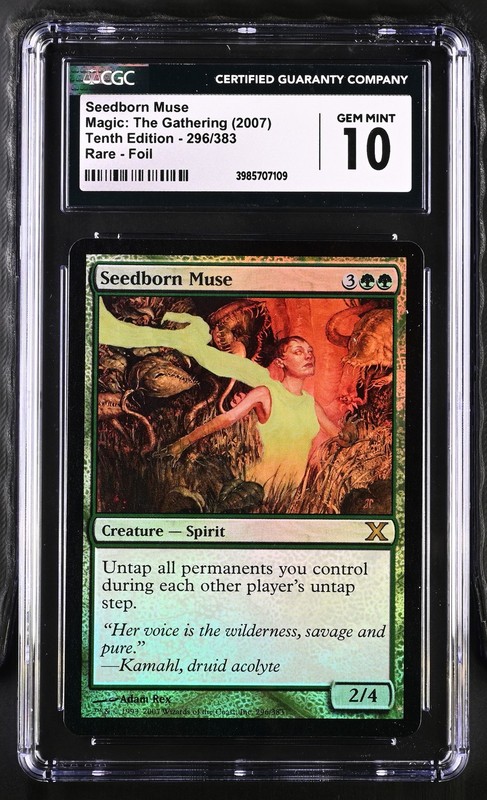
Seedborn Muse stands as the current titan among 10th Edition chase cards, commanding a raw price of $79.99. This premium valuation is a clear indicator of its desirability within the Magic: The Gathering collecting community. Typically, cards that untap all permanents during each player’s untap step are highly sought after for their combo potential and game-altering impact. In its foil iteration from 10th Edition, the combination of power and premium finish likely fuels its top-tier pricing.
The grading play for Seedborn Muse [Foil] is currently speculative, given the absence of PSA 10 data. However, if a significant multiplier emerges for Gem Mint 10 graded copies, raw acquisition for submission could become a lucrative strategy. The current raw price suggests a high floor, and its position as the set’s leading card makes it a prime candidate for grading enthusiasts.
Buy Seedborn Muse on TCGPlayer Buy Seedborn Muse on eBay
2. Abundance [Foil]
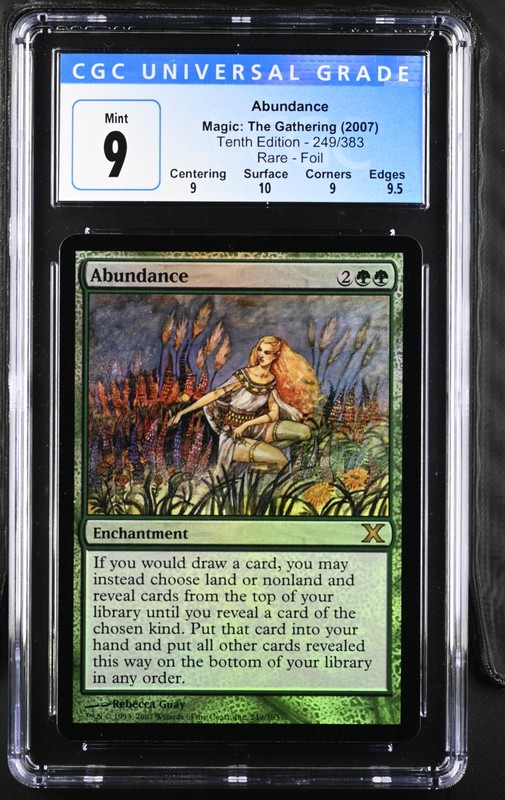
Following closely is Abundance [Foil], with a raw price of $73.61. Abundance is known for its ability to ensure a steady stream of land drops, a cornerstone of many powerful Magic decks, especially in Commander and other singleton formats. Its consistent utility, combined with the eye-catching foil treatment, positions it as a strong secondary chase card in 10th Edition.
The investment potential for Abundance [Foil] mirrors that of Seedborn Muse. Without established PSA 10 comps, the grading strategy is a gamble based on projected demand for high-grade copies. However, its relatively high raw price suggests that collectors are already valuing it significantly, making it a worthy consideration for grading if the market trends favorably towards PSA 10 specimens.
Buy Abundance on TCGPlayer Buy Abundance on eBay
3. Time Stop [Foil]
Time Stop [Foil] rounds out the top three chase cards with a raw price of $69.99. Time Stop is a unique and often game-swinging counterspell that effectively skips the opponent’s turn. Its ability to completely alter the course of a game makes it a memorable and powerful card. In its foil 10th Edition form, this iconic spell is a clear target for collectors.
The grading opportunity for Time Stop [Foil] depends heavily on future market data for graded copies. As a unique effect, it holds perennial appeal. If PSA 10 valuations begin to climb, acquiring raw copies for grading could prove to be a profitable endeavor. Its current high raw price indicates strong immediate collector interest.
Buy Time Stop on TCGPlayer Buy Time Stop on eBay

4. Grave Pact [Foil]
Grave Pact [Foil] sits at the fourth spot with a raw price of $58.08. Grave Pact is a notorious engine for attrition-based strategies, especially in black-heavy Commander decks, where it forces opponents to sacrifice creatures when a creature dies. Its powerful disruptive ability makes it a consistent demand driver for Commander players and collectors alike.
For collectors considering grading Grave Pact [Foil], the current lack of PSA 10 data means a degree of foresight is required. Its strong performance in Commander circles suggests that demand for high-grade copies could be significant. If the grading multipliers prove favorable, this foil could represent a solid grading investment.
Buy Grave Pact on TCGPlayer Buy Grave Pact on eBay

5. Root Maze [Foil]
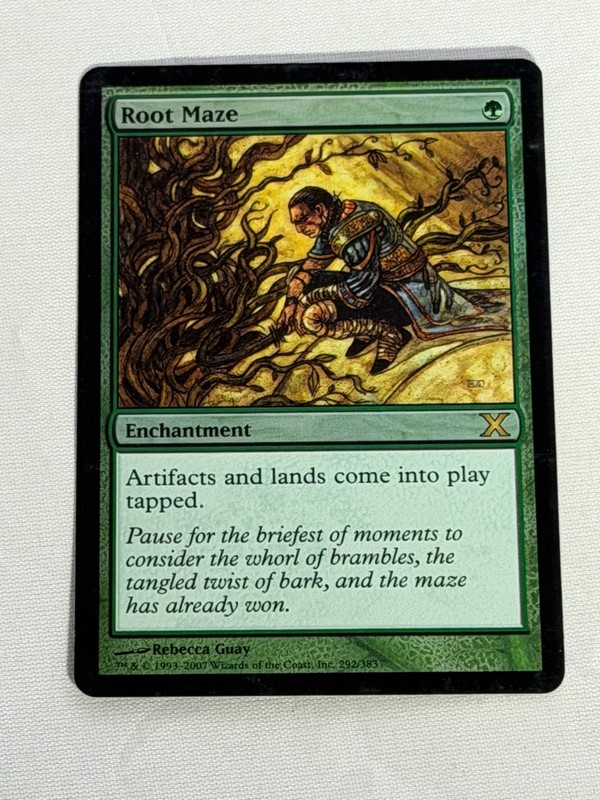
Root Maze [Foil] is valued at $56.39 raw, securing its place as the fifth most valuable chase card in 10th Edition. Root Maze can significantly slow down opponents by taxing their mana to cast spells. While its impact can be metagame-dependent, it offers a unique form of control and disruption that appeals to certain playstyles and collectors.
The investment angle for Root Maze [Foil] is contingent on the establishment of PSA 10 pricing. Its current raw valuation indicates a healthy level of collector interest. If the market eventually favors graded copies, then raw acquisition for grading purposes could yield positive returns, especially given its position within the top tier of chase cards.
Buy Root Maze on TCGPlayer Buy Root Maze on eBay
6. Doubling Cube [Foil]
Doubling Cube [Foil] is valued at $55.00 raw, making it the sixth highest-priced chase card. Doubling Cube is a notoriously powerful artifact that can exponentially increase a player’s mana. It’s a card that enables truly explosive turns and is a favorite in high-mana strategies, particularly in Commander. Its unique game-winning potential makes it an attractive collectible.
From a grading perspective, Doubling Cube [Foil] presents a similar outlook to the other top cards. The absence of PSA 10 data necessitates careful market observation. However, its high raw price suggests a strong collector base, and if graded copy valuations rise, then submitting raw cards could become a profitable strategy.
Buy Doubling Cube on TCGPlayer Buy Doubling Cube on eBay

7. Graveborn Muse [Foil]
Graveborn Muse [Foil] is currently priced at $47.41 raw, ranking as the seventh most valuable chase card. This creature draws cards equal to the number of creatures you control as it enters the battlefield and draws an extra card during your upkeep, providing significant card advantage. Its name is listed with card number 145. It’s a potent engine for graveyard-themed decks and general value generation.
The grading potential for Graveborn Muse [Foil] is tied to how the market values PSA 10s of this card. Given its substantial raw price, it suggests a good existing collector demand. If PSA 10 multipliers become favorable, acquiring raw copies to submit for grading could prove to be a wise investment choice, particularly for those looking to capitalize on high-grade premiums.
Buy Graveborn Muse on TCGPlayer Buy Graveborn Muse on eBay
8. Elvish Champion [Foil]
Rounding out the top eight is Elvish Champion [Foil] at $41.19 raw. Elvish Champion is a classic lord-type creature that empowers all Elves, granting them +1/+1 and forestwalk. This makes it a staple in Elf tribal decks, which are popular in Commander and other casual formats. Its status as a tribal enabler contributes to its collectible value.
For Elvish Champion [Foil], the grading strategy hinges on future PSA 10 market data. Its current raw price is respectable, indicating a solid baseline of collector interest. If graded copies start to command significant premiums, then buying raw for grading could offer a solid ROI. It’s a card with established demand in a popular tribe.
Buy Elvish Champion on TCGPlayer Buy Elvish Champion on eBay

Investment Analysis
Grading ROI across the set
While concrete PSA 10 data is scarce for 10th Edition, the current raw prices for its top foil chase cards suggest potential for profitable grading. Cards like Seedborn Muse [Foil] ($79.99 raw) and Abundance [Foil] ($73.61 raw) are prime candidates. If the market develops a strong multiplier for PSA 10s – for example, a 2-3x increase over raw prices – then acquiring these cards raw and submitting them could yield significant returns. The strategy hinges on identifying which of these high-demand foils are most likely to achieve Gem Mint status and command a premium.
Complete-set cost
The sum of the top 8 chase cards’ raw prices is $481.66. This serves as a lower-bound floor for a complete raw collection of just these key cards, not the entire set. Considering that 10th Edition is a core set, likely printed in higher volumes, the multiplier for commons and bulk to reach a complete set cost is estimated between 1.0x and 1.2x. This suggests a total raw set acquisition cost could range from approximately $481.66 to $578, excluding any non-foil rares, mythics, or parallel printings that might exist. This estimate doesn’t account for the potential added cost of high-grade singles if pursuing a graded set.
Short-term vs long-term view
In the short term (90 days), the market for 10th Edition chase cards is likely to be driven by initial collector uptake and speculation, especially around the foil variants. Prices could see fluctuations based on perceived demand and early grading results. The long-term view for 10th Edition, as with most core sets, will depend on its role in competitive play (if any) and its evergreen status in formats like Commander. If key cards maintain or increase their playability and nostalgic appeal, their collectible value, particularly in foil, could see steady growth over several years.
Risks
The primary risks for 10th Edition collectors include reprint potential, as core sets are prone to seeing their most popular cards reappear in future products, diluting scarcity. Set rotation in competitive formats, while less impactful for collectibles than playability, can shift demand. Furthermore, changes in grading company policies or a saturation of graded copies in the market could impact the premium commanded by PSA 10s. The lack of immediate PSA 10 data also represents a risk, as the market may not develop the expected multipliers.
Pro Tip: When evaluating potential grading targets in a new set like 10th Edition, prioritize cards that are iconic, possess strong strategic value in popular formats (like Commander), and have a visually appealing foil treatment. Focus on acquiring raw copies with excellent centering and sharp corners, as these are critical for achieving a high grade like PSA 10.
Worth Collecting? The Verdict
Verdict: WATCH. 10th Edition MTG is a set that warrants a cautious “WATCH” for collectors in 2026. The current raw market for its foil chase cards, headlined by Seedborn Muse at $79.99, shows promising initial value, but the lack of graded population data means significant upside for grading is still speculative.
-
The TCG Collectibles Completionist: For those aiming to complete the entire 10th Edition set, it’s a “BUY” if you can acquire commons and uncommons at bulk rates and are strategically targeting the foil chase cards at their current raw prices. The estimated complete-set floor is accessible, but vigilance is needed as prices may fluctuate.
-
The ROI-Focused Investor: This set is a “WATCH” for ROI investors. While the top cards have strong raw prices, the absence of PSA 10 data makes grading a higher-risk proposition. Monitor the emergence of PSA 10 market trends closely; if favorable multipliers appear, a “BUY” for grading submissions could be justified.
-
The New Collector with $240 to Spend: For a new collector with $240, 10th Edition is a “WATCH,” leaning towards selective “BUY.” Focus on acquiring one or two of the top foil chase cards, such as Seedborn Muse or Abundance, at their current raw prices. Avoid trying to complete the entire set with this budget; prioritize the highest-impact singles.
Frequently Asked Questions
Is 10th Edition MTG a good investment in 2026?
10th Edition is a “WATCH” for investment in 2026. Its foil chase cards, like Seedborn Muse at $79.99 raw, show early potential, but the lack of established graded market data introduces a speculative element. Focus on acquiring key foil singles rather than bulk for the best potential return.
What are the most valuable cards in 10th Edition?
The most valuable cards in 10th Edition are its foil chase cards. As of July 2026, Seedborn Muse [Foil] leads at $79.99 raw, followed by Abundance [Foil] ($73.61) and Time Stop [Foil] ($69.99). These cards represent the highest collector demand and market value within the set.
Should I grade cards from 10th Edition?
You should consider grading cards from 10th Edition cautiously. While cards like Seedborn Muse [Foil] and Abundance [Foil] have high raw prices, there is currently no definitive data on PSA 10 median prices. This makes grading a speculative play, best suited for collectors willing to monitor market trends and target cards with excellent physical condition.
How much does it cost to complete a 10th Edition set?
The cost to complete a 10th Edition set is estimated to be between $481.66 and $578 for the raw singles, based on the sum of the top 8 chase cards and a conservative multiplier for the remaining commons and bulk. This figure excludes the cost of foils, rares, mythics, or graded versions of any cards.
Is 10th Edition MTG rare?
As a core set released in 2026, 10th Edition is likely to have been printed in significant quantities. Its rarity will be determined more by the scarcity of its specific chase cards, especially in foil and high-grade condition, rather than the set as a whole. Key singles will hold value due to demand, not overall set scarcity.
For more insights into the Magic: The Gathering market and to explore other valuable sets, check out our Magic the Gathering Card Market Trends 2026 and discover opportunities in the MTG Reserved List Investment 2026.